Country of Honour – South Korea
No Barriers, No Nations: Transnational Expansion in Contemporary Korean Documentary
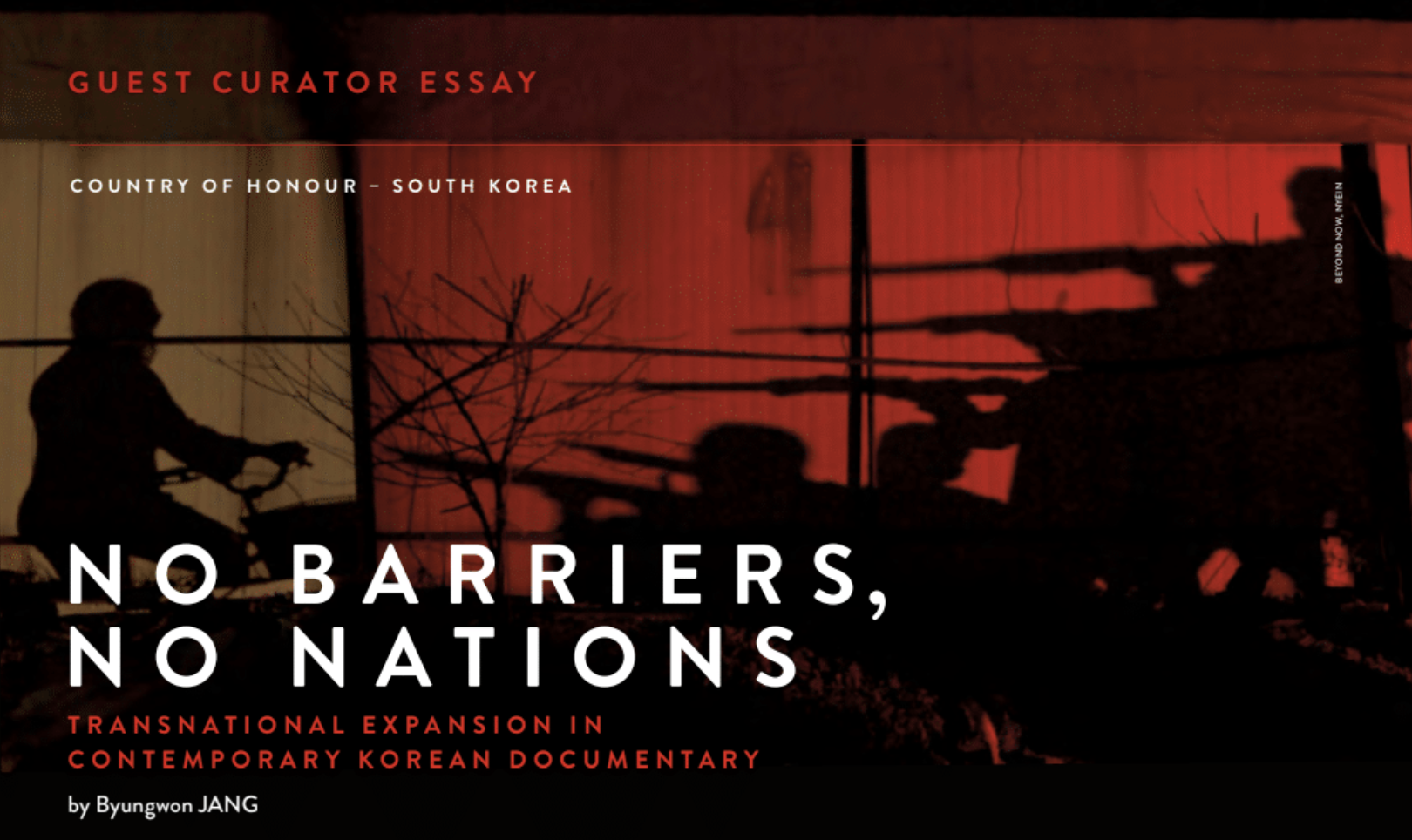
Choi Jin-Bae, a Korean man, and Nyein Thazin, a Myanmar woman, are an international couple and the protagonists of Beyond Now, Nyein (2025), directed by Lim Dae-Chung. The film follows the inner journey of Nyein Thazin as she settles in South Korea after fleeing the political turmoil following the military coup in Myanmar. Lim Dae-Chung accompanies the couple through their turbulent times following the 2021 coup. During the COVID-19 pandemic, Choi Jin-Bae manages the Facebook page 'Myanmar Today' in support of Myanmar's democratization movement, communicating with activists in the region through photos and videos sent by Nyein’s acquaintances. These images bear witness to the violence perpetrated since the coup, the threats faced by the resistors and the deaths that continued to mount. While Choi works as a delivery platform rider and Nyein as a restaurant worker in Korea, the couple also organizes activities in solidarity with Myanmar’s pro-democracy movement. Their lives unfold across national borders, linking the political crisis in Myanmar with everyday life in South Korea.
The transnational imagination of contemporary Korean documentaries spearheaded by Beyond Now, Nyein demands a new perspective that transcends nationalism grounded in ethnic homogeneity and the binary between victim and perpetrator. These films adopt a posture of resistance against nationalistic thinking—a mechanism that translates identity into the formula of "state-nation-citizen" to construct and guarantee national borders. Two films that deconstruct the elements of the "state" and foreground geopolitical reversals are Lee-Kil Bora’s Untold (2021) and Jeong Yeoreum’s The Silent Bearers (2023). Rather than translating the shared memory of a location into the temporal experience of a homogeneous national space, these films depict how a sense of place within a territory becomes articulated as ethnic identity from distinct perspectives.
In these two films, both of which take the Vietnam War and South Korea's participation in it as a motif, the state occupies a dual status—oscillating between dominance and subordination, center and periphery—in relation to imperialist wars. Untold, which unearths dark memories of civilian massacres by South Korean troops during the Vietnam War, focuses not on Korea’s victimhood as a country involved as a U.S. ally, but rather on its perpetratorhood as a central theme. To present a perspective that transcends nationalism based on belonging and kinship, Lee-Kil Bora chooses an approach of "historical mirroring." Through the memories of her grandfather, a Vietnam War veteran, she questions how we, as citizens of a perpetrator nation, should re-examine and remember war and massacres. The film inherently views the war as more than just a fight between Vietnam and the U.S., noting that Korea achieved economic growth and geopolitical goals through the dispatch of combat troops, supply of military goods and economic development programs.
Lee-Kil Bora raises questions about the ambivalent attitude of Koreans who, while persistently demanding accountability for Japan’s war crimes, remain silent about—or deny—the massacres committed during the Vietnam War. The intimidation and violence displayed by Korean Vietnam veterans in response to Nguyễn Thị Thanh’s demand for an apology and compensation from the Korean government mirror the stance of the Japanese right wing, which similarly distorts and denies the history of occupation. Korea’s experience of imperialist aggression under Japanese rule and its later role as a perpetrator in the Vietnam War confront each other like two shots filmed from reversed camera positions, each reflecting the other from an opposing historical vantage point. By juxtaposing these histories, Lee-Kil Bora suggests that they can be understood more critically only by detaching from national interests, dismantling the boundaries of the nation-state, and adopting the perspective of an East Asian, an Asian, and ultimately a global citizen. In this way, Korean consciousness of the Vietnam War moves beyond the binary framework of dominance and resistance between metropole and colony, revealing instead a pattern of “mimicry.”
Visual artist and experimental documentary filmmaker Jeong Yeoreum presents another mirror image in The Silent Bearers (2023). Hailing from Dongducheon-si, home to U.S. military bases, Jeong has explored regional issues influenced by foreign soldiers. In The Silent Bearers, she retraces violence inflicted on the outside world through the eyes of an insider. The film follows a journey tracing the remnants of the Vietnam War and its aftermath, continuing Jeong’s interest in assigning meaning to the nature of place by exploring thick sedimentary layers of history and memory. Jeong explores the process of departure from original meaning through the reality where the shocks and ruins of war are consumed as tourism products today. She uncovers images of places like Da Nang, Khe Sanh and Nha Trang—symbols of the tourism business—and the tragic remnants of the past hidden behind them. The narrative clue is the guidance of 'Min,' a former South Vietnamese soldier met on the third day of the trip, and the essence of the form is the relationship between audiovisual elements played across two channels. Two systems, two nations, two votes and two channels create exchange, contrast and conflict. By approaching the state as a place excavated by history, ideology and the act of remembering itself, Jeong collapses all attempts to define a city's identity as a single monolith comprising fragments of national records, mythical narratives, and personal memories.
A recurring geopolitical feature of Korean transnational documentaries is the "erasing of barriers" through narratives centered on peripheral subjects. The protagonists or narrators of these films are those who have left their original places of residence: political migrants or exiles. Situated between their home country and a foreign land, they experience a form of boundary confusion in which subjectivity becomes detached from place-based identity, forcing them to adapt and assimilate. At the same time, these peripheral figures occupy ambiguous positions within the nation-state, forming spaces that are difficult for the state to fully incorporate, and thereby destabilizing both ethnic identity and the authority of the state itself. Beyond Now, Nyein is a film of an exile that vividly portrays this experience of separation. While Nyein Thazin appears as a complete outsider in Korean society, she also functions as a subject of substitution, reading the Korean landscape through the political memory of her homeland, Myanmar. As she observes landscapes that evoke both strangeness and familiarity, Nyein’s sense of loss, anxiety and longing for her home country repeatedly surfaces through a series of shots reflecting her inner consciousness. Images of the situation in Myanmar, broadcast from a television monitor installed along the roadside, externalize her inner landscape. This 'theater of consciousness' does not function as a space representing the nation-state through a single signifier; instead, it reappears as a site where soldiers in uniform persecute and massacre resisting citizens.
Another symbolic object recalling Myanmar in Beyond Now, Nyein is the bicycle. The bicycle is a medium connecting the relationship between Nyein Thazin and Choi Jin-Bae, and a mirroring object linking the political situations of Myanmar and Korea. The scene of Choi moving his bicycle after receiving a delivery call is depicted with calculated compositions and camera work. The camera follows the movement of the bicycle gliding along the road; in this slow sense of motion, there is no urgency to arrive before the delivery deadline. The vertical movement of Choi’s bicycle overlaps with a bicycle movement scene in the middle of the film that corresponds to Nyein’s fantasy (or dream). Nyein’s bicycle, imagining the atrocities suffered by family and friends in Myanmar, moves windingly through the dark night streets, staging her desolate inner landscape. At every corner she passes, Nyein hears voices announcing persecution, torture, massacre, and threats. Nyein’s bicycle can be seen as a counter-shot to Choi’s—their gentle bicycle movement transcends geographical coordinates to connect the two countries.
The rhetorical strategies representing documentaries with transnational expansion tendencies are "juxtaposition" and "substitution." Arief Budiman’s short film Last May in Theaters (2025) offers a particularly eloquent example. Drawing on the medium-specific properties of cinema, this experimental documentary uses immersive images generated by AI to place Gwangju in 1980 and Jakarta in 1998 side by side. Two historical moments marked by state violence are connected through the shared spatial memory of the movie theater. Gwangju Cinema, a historic theater in the southern Korean city, stood at the center of the May 18 Democratic Uprising, while the Buaran Theater in Indonesia bears witness to the protests and riots that erupted in Jakarta in May 1998. The similarity between the two spaces lies in their function as sites of collective spectatorship. Building on this parallel, Budiman—whose work has frequently explored how Indonesia remembers its history of violence—constructs a transnational connection between the two events, using this historical similarity as a point of contact. Testimonies of people who protected the theaters during unrest, together with archival footage, are reprocessed to restore another side of history. What ultimately connects these two events across temporal and geographical distance is the shared experience of state violence across Asia, as well as the political potential embedded in cinema itself. The film thus emerges as a critical reflection on the democratic possibilities of cinematic practice: recording, reflecting on and collectively witnessing reality across national and historical boundaries.
In the midst of military coups in Korea and Myanmar (occurring with a time lag), alongside the resurgence of right-wing nationalism fueled by political and economic crises—such as the Russian invasion of Ukraine, China’s quest for hegemony, and the rise of new Asian nationalisms in increasingly authoritarian states like India—what does transnational cinema mean? Within this rapidly shifting geopolitical context, transnational documentaries demonstrate their capacity to create modes of exchange and solidarity through the intertwined histories of movement, aesthetics, politics and ideology. From Nyein Thazin’s experience of displacement in Beyond Now, Nyein to the historical mirroring in Untold and The Silent Bearers, and the spatial juxtaposition in Last May in Theaters, these films show how cinema can traverse borders, connect distant struggles and reimagine political, ethical and aesthetic relationships across Asia. The radical imagination of such documentaries—claiming to discard the consciousness of state and nation that has long governed the Asian psyche—provides powerful evidence of the transnational potential of film as a medium of mediation, reflection and solidarity.